
Last Wednesday I had a really interesting and enjoyable time in the company of recent fledgling hawks, 4 Ferruginous Hawk fledglings to be more exact. After seeing 1 fledgling initially, I followed it flying ever-closer to the rarely used farm road where I have been observing a familiar adult pair throughout the nesting season. When the fledgling landed near the road I hoped my slow, steady approach would get me within camera range. As I stopped and turned off the car’s engine, I realized there was another fledgling standing in the shade of the adjacent wooden utility pole, eating; but the fledgling that just landed was in perfect sunlight for a couple documentary photos to show the plumage of a typical Ferrug fledgling.
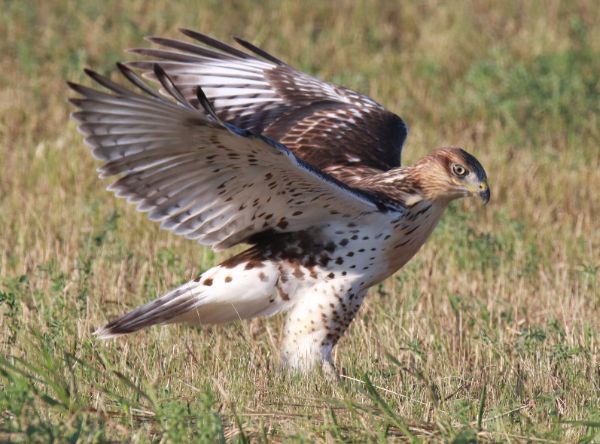
Now that I was in a good position to observe the fledglings, the first fledgling walked a few steps at a time, looking down inquisitively, grabbing into the grass occasionally, perhaps reacting to movements of insects in the newly cut hayfield. Soon I also noticed the outline of a head low in the grass in front of the feeding fledgling – a third Ferrug fledgling, which was significant because I only saw 2 the past couple times I monitored the fledging progress. In fact, a fourth fledgling eventually flapped into view, originating from high grass next to the. While that may not seem significant to photography, an important part of photographing birds brings us closer to our subjects and often provides the chance to spend a little more time in their company to observe behaviors between photo bouts.
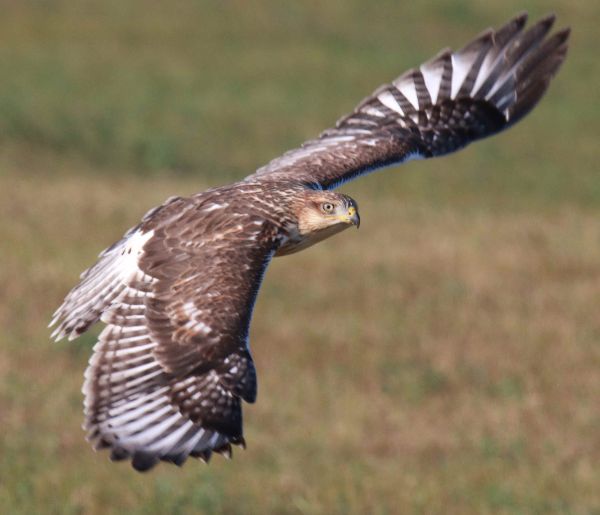
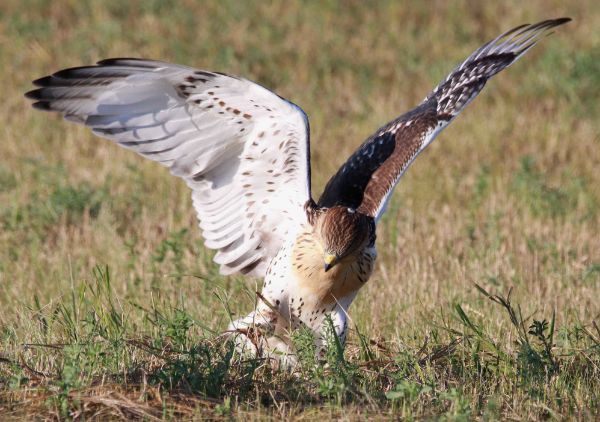
But back to the fledgling photography ops: After feeding, the second fledgling stepped into the sunlight and looked around a moment, which made me pre-focus on the young hawk in case it interacted with a sibling or took flight. That happened to be intuitive, because without notice the hawk took flight, actually turning in my direction as it veered from its takeoff course, thereby providing a nice spread-wing flight image. With that fledgling satiated and landing 150 yards north, the first hawk walked to the food source and began spreading its wings high above its back, then jumping in the air, spinning, flapping, jumping again and again, all while holding the remnants of a Richardson’s Ground Squirrel in its talons during most of the actions.
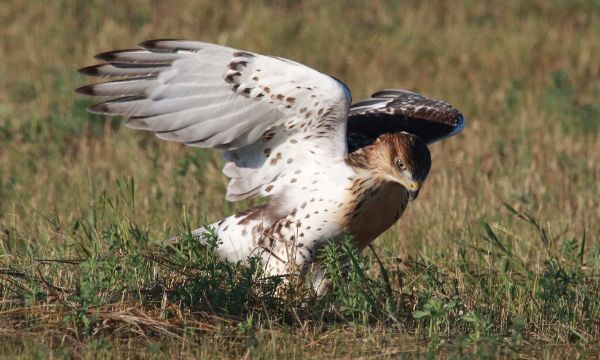
To me, this looked like a “play-hunting” or “practice-hunting” behavior that precedes actual hunting and continues through the post-fledging period while raptors learn to hunt small rodents on their own. The action continued on and off for a few minutes, providing a number of photo opportunities as the young hawk appeared to be rejuvenated as the temperature cooled from heat that reached the 90s throughout the week. With my camera’s Al Servo set at “continuous,” when I depressed the shutter button continuously, my camera took 5 photographs per second, providing an exciting fast-action series of photographs as the hawk jumped into action. It was a very fun opportunity and I made the most of it.
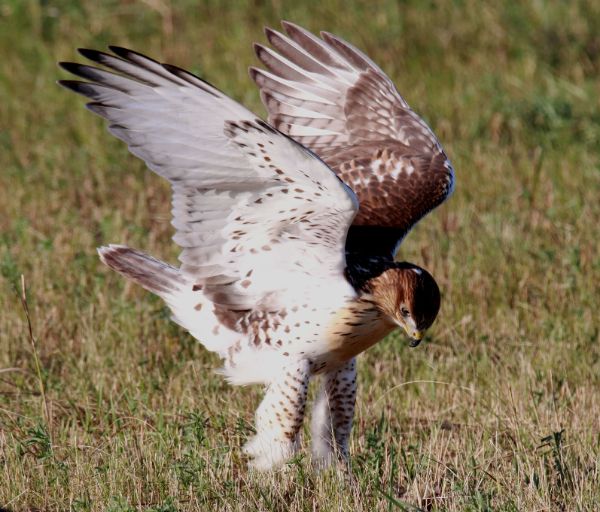
As the fledgling became more active, I zoomed my lens back to a lower magnification to increase the area surrounding the hawk in the photo frame, but the hawk surprised me by jumping higher than anticipated. As a result, the ends of the wing feathers were often beyond the top of the photo frame. And even though the lighting was good, the young hawk kept its back to the sun most of the time, and with all the wing flapping action and twists and turns on the ground and above ground, shadows were a factor in several photos. However, that’s where reviewing and editing photos comes in – and the review process and photo cropping can be the most important part of adding to the details of any photo, after you manage to take some quality photographs to choose from. Even so, this was one of my best opportunities to photograph the early hunting practice of young birds of prey to date, and they stand among my best photos of fledgling hawks.
The period after young birds leave the nest is an especially important post-fledging learning period, when they learn to fly and, in the case of young raptors, learn to hunt – all while under the protection and of the adults that also provide food during the weeks after leaving the nest. Neither the fledglings nor the adults were concerned about the presence of my parked car, which I use as a mobile photo blind; but I always keep the birds in mind and back away if I get the impression the birds are not comfortable. The birds’ well-being always comes first, and that is especially true during the post-fledgling period. But it was clear that these hawks were not only unconcerned, but were behaving in very natural, rarely observed ways. Good Luck during all your bird photography outings, and keep your camera within reach – you never know when an interesting bird will alight within sight.
Article and Photographs by Paul Konrad
Share your bird photos and birding experiences at editorstbw2@gmail.com