
It seems I’ve been on a 3-state tour during the past week, but I’ve slept in my own bed every night – ha. Friday I crossed the Dakota border to enter the South state to take advantage of a sunny evening to check for photo opportunities at Hecla Marsh. The first birds I observed on the water were Western Grebes, including a female that had 3 very young hatchlings riding on her back. The downy hatchlings were often covered beneath a blanket of the female’s somewhat elongated back feathers, popping out of cover one by one at times. It seemed early for the first downy grebes to have hatched, but it was a bright surprise for someone who was itching to give his camera a workout.
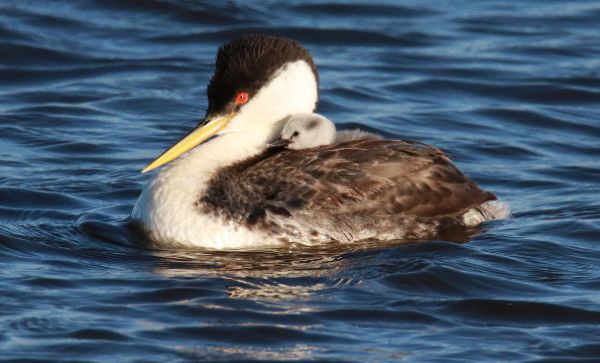
The second surprise was a second adult female with her own trio of downy hatchlings on her back, and each family group was attended by a male that would periodically bring a small fish for the hatchlings and female. Luckily, both females with back riders were positioned close enough to the shoulder of the road for me to park my car near their action point; and the males were even closer as they searched for small fish in the shallows underwater. There may have been 40 grebes in sight, with others probably incubating on hidden nests – so having the only 2 pairs with newly hatched young so close was a treat that kept on giving as the Westies provided an array of photo ops.
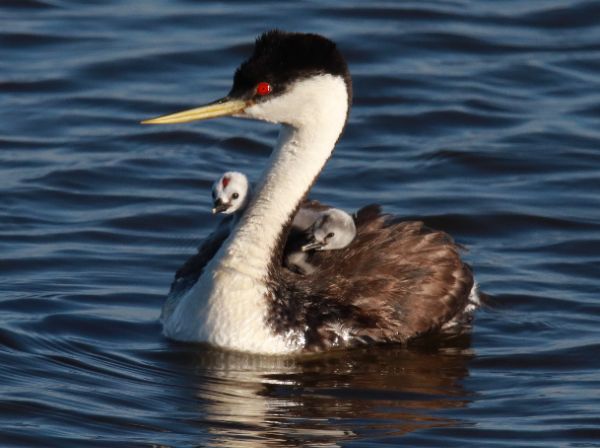
From the start, I mostly concentrated on trying to photograph the cute downy hatchlings when they poked their heads out of the blanket of feathers where they rested and slept, a lot, as expected for newly hatched waterbirds. But at key moments they revealed themselves 1, 2, or 3 at a time – offering some initial photos with the female, some even showing a level of intimacy between the adult and its young. The downy hatchlings became especially alert when they heard the low call of the male as it approached with food. As he met the female there was usually a food exchange between the male and female, and the male would return to fishing.
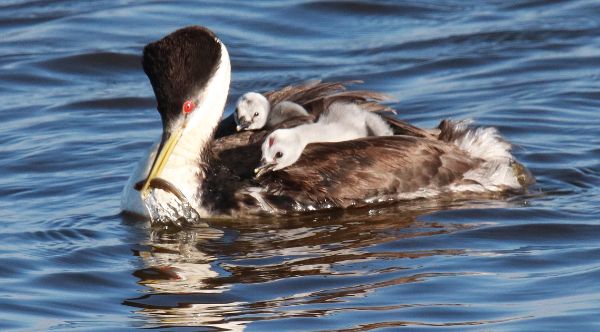
In the meantime, the female seemed to get the downies excited by dipping the fish in the water, perhaps to facilitate swallowing it, then holding it above the reach of the hatchlings before repeating the process. Eventually the female permitted the most excited downy to grab the small fish and swallow it, not without a level of difficulty as the tiny grebe downed the oversized fish a number of deep gulping actions. The interactions between the adults and their new hatchlings were especially enjoyable to watch, and to photograph – heartwarming at times. And when an over-enthusiastic hatchling vying for food fell off the female’s back and into the water, it created a humorous moment, which turned to slight concern as the little one instinctively swam around to the tail of the female and clumsily climbed aboard her backside again.
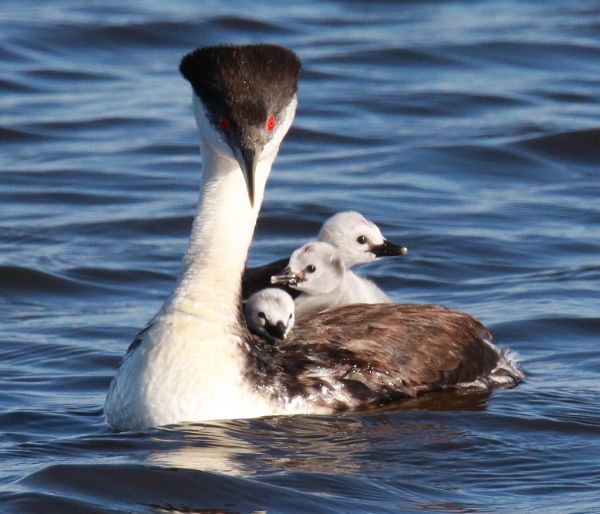
All the while I was photographing, it seemed I was provided with pretty perfect evening sunlight at a low angle; the kind of natural light I prefer and that works well in almost every case. The tiny images I checked on my camera’s LCD screen looked good, but when I returned home and reviewed the photos on the large screen of my laptop, it was all too obvious that there was a bit of a problem with over-exposure of most of the Western Grebe photos I took. My take on the problem was the bright white neck of the adults compared to their dark gray-brown body plumage caused the white plumage be over-exposed. This was probably because I focused my center-point light meter on the dark body plumage, which resulted in the body plumage being reproduced in true colors or slightly lightened, that shows more color details, but the white plumage shows few details and looks over-exposed bright-white in many photographs.
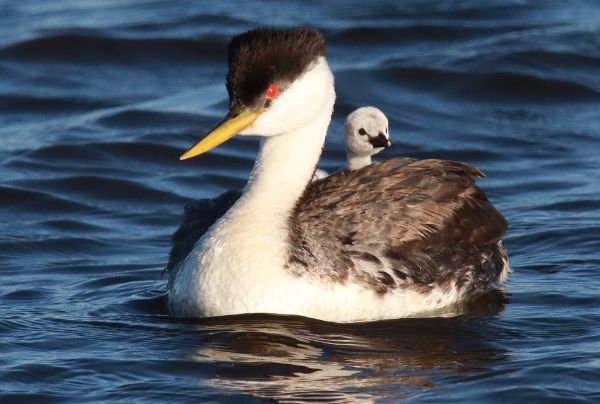
In retrospect, I wish I had remembered a lesson I learned when photographing adult Bald Eagles. I tended to focus on the brown plumage on the shoulder of the eagle rather than white plumage of the head. That practice provided nice color details of the body and wing feathers, but it usually over-exposed the white plumage of the head and neck. That result led me to focus on the eye of an adult eagle, which provided a truer color of white plumage that shows some details in individual feathers. This practice also provided a truer color of the brown body and wing plumage that was a bit darker than it showed when I focused on the brown shoulder plumage.
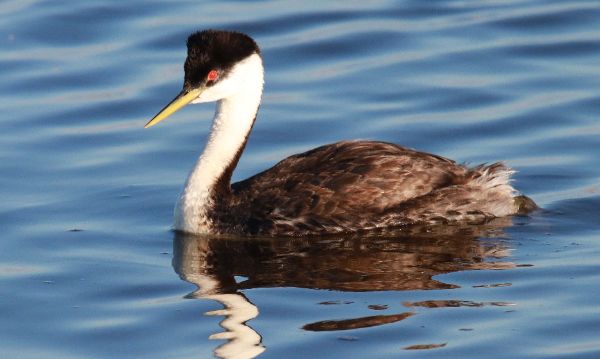
I wrestled with the white-dark plumage a bit in my mind as I photographed the Western Grebes, and I even tried to focus on the hatchlings on the adult’s back as a median option, which may have helped. In the end, it was a fine-tuning learning experience that only comes with experience, or when we read articles like this. In the end, it was the time alone in the midst of a beautiful marsh on a sweet June evening surrounded by the sights and sounds of birds – a favorite way to get away and enjoy being a part of nature – with my camera. I hope you have the pleasure of enjoying your next photo session with that level of gusto.
Article and Photographs by Paul Konrad
Share your bird photos and birding experiences at editorstbw2@gmail.com