
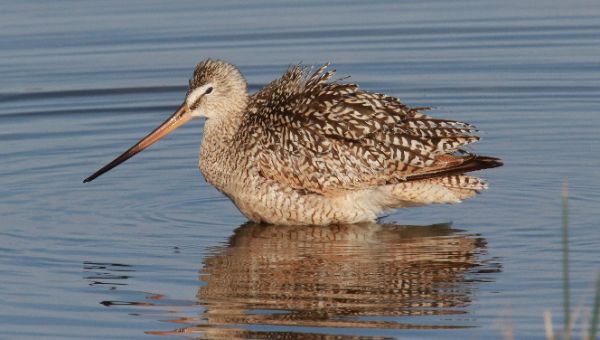
Action photos usually provide the best examples of bird photography, and birds are very active animals that lend themselves well to taking action photos. Recently I had a chance to take a series of action photographs that I could actually anticipate and prepare for in advance to make the most of the opportunity to take a series of action photographs. A pair of Marbled Godwits has frequented the northwest bays of a favorite photo location – Charo Marsh – and while a mixed group of shorebirds was foraging in the area, a Marbled Godwit stopped before me and provided a nice portrait. But without hesitation she lowered her body into the shallow water and began bathing, an initial opportunity to take some action photographs.
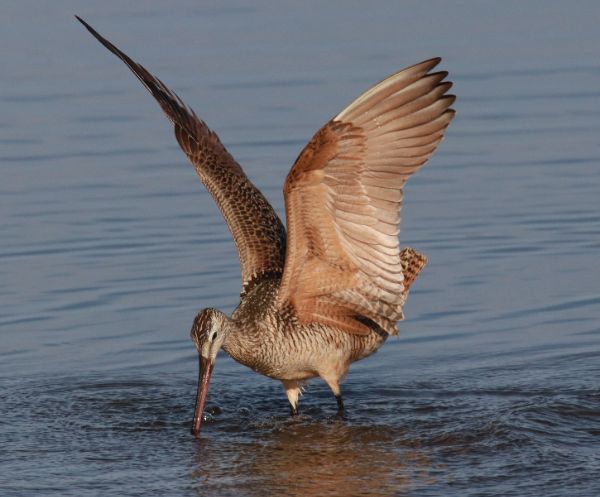
That’s great, but I knew the best action photo opportunities would very abruptly explode into action at the end of the bath. Knowing this is a plus for any bird photographer who is looking for an action photo or series of photos: With many birds, and with sandpipers and plovers in particular, the bathing bird will suddenly stand upright, spread its wings and begin flapping to shed the water clinging to its plumage. This also helps the feathers reposition into their normal positions, and the bird may then ruffle its body feathers and begin preening – all part of the potential action during and after a bathing session that you can anticipate and photograph.
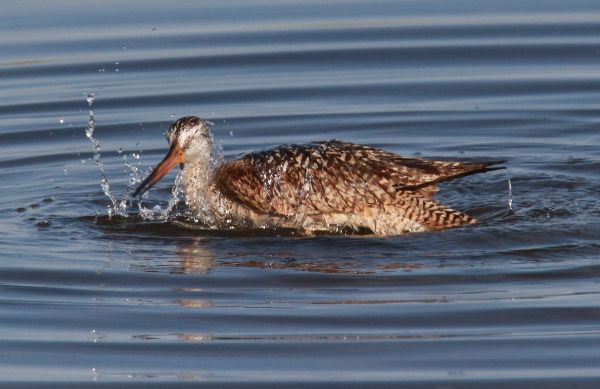
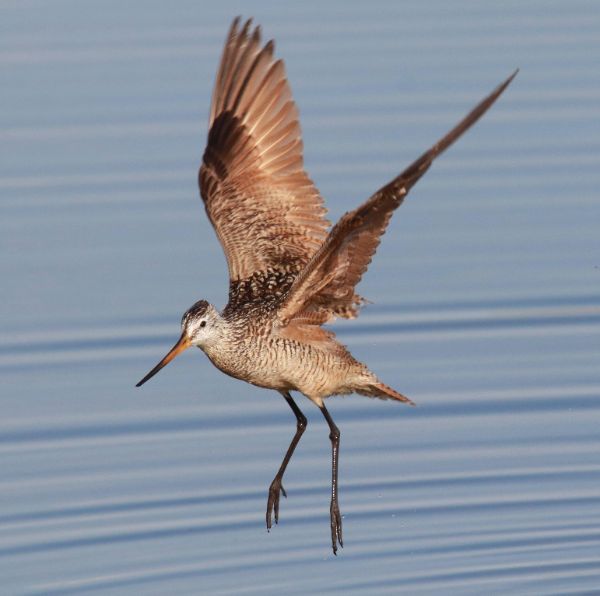
As the bird finishes bathing, it will stand upright and flap its wings, which provides an excellent opportunity to photograph that action. The strength of the flapping sometimes is even enough to elevate the bird just above the shallow water a moment before touching down at the end of the flaps. In the case of this Marbled Godwit, I was quite surprised that she continued the sequence with more than the anticipated wing flaps. The big sandpiper actually elevated to the point of taking a short flight closer to shore, permitting me to keep photographing during the extended photo opportunity. And that’s when the godwit did a little plumage ruffle for me to photograph as an endpiece to my photo series. All this in the realm of clear sky reflecting on the water with sunlight illuminating the bird and scene at a 40-degree angle above the horizon, which eliminated shadows and provided uniform colors. This is just one example of how you can use your experience with birds to realize what activity will follow a bathing session, then prepare and anticipate the action before and during the behavioral sequence.
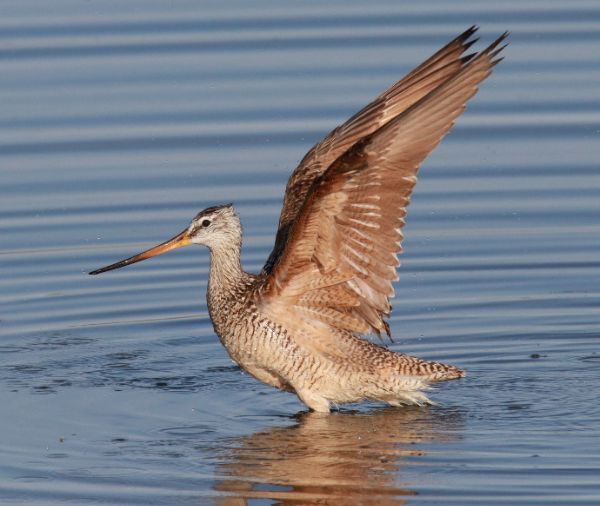
Tech Talk: The key to taking advantage of this excellent action photo opportunity is to be aware, then settle in to wait for the post-bath flap. As you wait, you can quickly double-check your camera settings to ensure you have a fast shutter speed, and adjust your aperture to a basic f-8 to have plenty of area in focus for a single bird, while also providing a fast shutter speed: 1/1000 or faster if possible, although 1/500 might be adequate if you are trying to stop the action of the wings. Another option is to try to blur the action of the wings, which will most likely happen with a shutter speed under 1/400, but that’s when it gets tricky, because it is hard to say how blurred the wing action might become. Trying to blur action to show motion tends to be more experimental, but it’s always worth trying, especially if you get more than one opportunity to photograph wing flaps.
At this point, let’s take the technical settings topic back to the basics, and I will share what has worked best for me when photographing wildlife, especially birds. First, I never use an automatic setting on my camera because the camera can’t and won’t be able to assess a bird photography situation better than I can. But I also don’t use a totally manual camera setting. I have found that by far the best option is to use the Aperture Priority (Av) setting on your camera’s Mode Dial. By using the Av setting, I can set the aperture and the corresponding shutter speed is provided in response. If I increase the area in focus by switching from an f-8 to an f-10, the shutter speed is reduced a bit; and when I change the aperture from f-8 to f-6, the shutter speed is increased.
As my standard ISO setting I use the 800 ISO under good lighting conditions. I only photograph birds during good lighting conditions – during late afternoon or early evening periods when there is ample sunlight. I keep the sun at my back so it illuminates the birds before me; if it is overcast, I do something else instead of photographing birds. Without sunlight, colors are muted, shadows are enhanced, and it is rarely possible to get a quality photo of a bird.
Other birds you may be able to photograph by anticipating wing flaps and other behavior after a bathing session are ducks and geese, cormorants, gulls, terns, and potentially any other birds you encounter that suddenly begin bathing. Even though you will undoubtedly take a number of photographs during the action, each photo could potentially stand alone, apart from the concept of a series. But when it comes down to it, a series of action photos takes your bird photography to another level. Good Luck with all your photo opportunities as we slip into the summer season.
Article and Photographs by Paul Konrad
Share your bird photos and birding experiences at editorstbw2@gmail.com