
During this period of May, it’s especially important to devote as much time to checking on local hotspots for new arrivals, especially birds that may only stop for a couple hours – if that – during their extensive spring migration that may have been initiated in the most southern nations of South America. Spending time at a shallow marsh with a bare shoreline, you may be surprised to see how some birds may make only a 15-minute visit to drink and possibly bathe after feeding in on bugs and worms in nearby field. And any day, any moment can suddenly reveal a rare or sought-after species that was far from your wildest thoughts, until – bam – a flock of Black-bellied Plovers stand before you! And that’s exactly what happened as I began my Saturday afternoon birding drive.
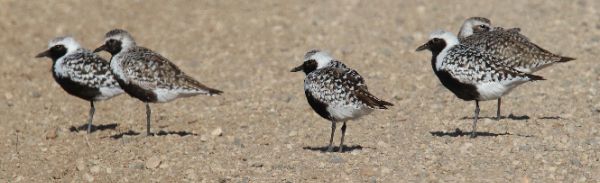
After urning east along a little used gravel road 4 miles south of my office, about a quarter-mile in front of me I could see a flock of birds standing in a line that spanned the road from north to south. Gulls and terns often loaf on this road that bisects a large marsh, and considering the size and black head and underside of the birds at a distance, they initially looked like Black Terns. But as I approached the flock I realized they were plovers, and a quick look through binoculars provided their true identity: Black-bellied Plovers! I have only seen this species in full alternate plumage 3 times before in Dakota, so this was an especially surprising and eventful sighting. In fact, the first time I sighted Black-bellied Plovers was in this very spot when I found 2 adults, which made this encounter all the more unlikely – but there they were, not 2, but 22 Black-bellied Plovers!
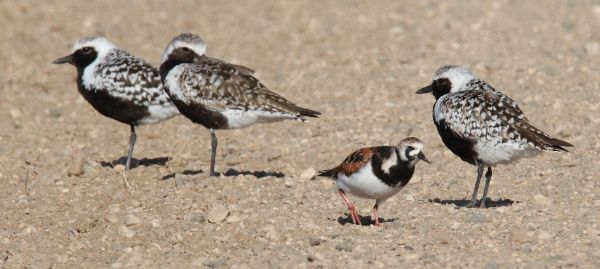
Black-bellied Plovers made my “quintfecta” complete for this spring, having seen all 5 of the rarest Arctic-nesting shorebirds I’ve ever encountered during spring migration – American Golden Plovers (Wednesday) with 4 Ruddy Turnstones, and 1 Buff-breasted Sandpiper; 2 Hudsonian Godwits (Friday), plus 28 Ruddy Turnstones (3 groups) and 22 Black-bellied Plovers (Saturday)! Last year was my first year of finding and photographing the Big 5 of distinguished shorebirds, and it was my first spring to see American Golden Plovers during spring migration Similarly, it is only the third spring to see the other 4 species (not during consecutive years). Hence, each of these Arctic-nesting shorebirds is especially rare during certain flocks’ brief migration stopovers.
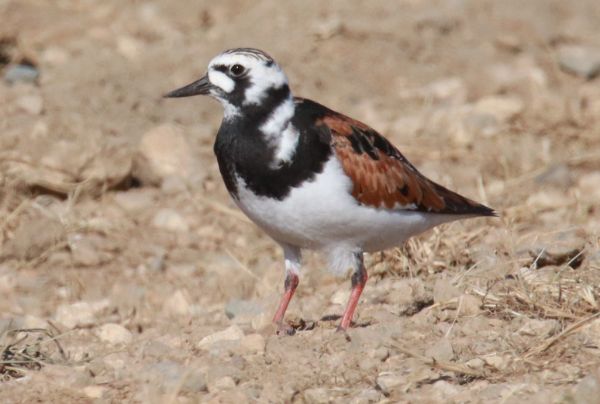
Among the gathering of resting Black-bellied Plovers were 2 Ruddy Turnstones and 9 Long-billed Dowitchers. Intent on hoping to photograph the plovers, I could see they were noticeably tired and some slept for periods as I moved my mobile blind (car) ever closer. Actually, I stopped for a few minutes to photograph, then pulled ahead a few more feet to let them get used to the white car. Eventually I could photograph them at relatively close quarters in the best light of the day (now about 5:30pm at this latitude). The turnstones on the other hand were actively foraging for newly hatched flying insects along the road and meandered around the resting plovers in the process. Other flocks of shorebirds flew in and out of the assemblage including 16 White-rumped Sandpipers and a few Baird’s Sandpipers that were also headed for the Arctic.
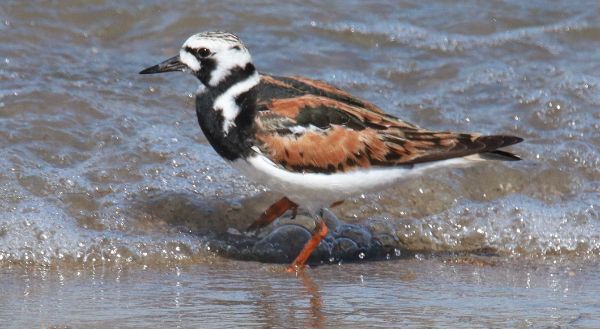
Back to Ruddy Turnstones, that morning I photographed a surprising flock of Ruddys on the narrow sandy beach on the southeast corner of Carlson Lake, about 6 miles north of the office. As I photographed the turnstones as they foraged among many Sanderlings, their numbers changed and steadily increased – from 5 originally to 10, to 15 and eventually I made a high count of 21. Photographing them was great fun and it was hard to break away after a half-hour. I also managed to get some nice flight photos of mixed flocks as the 2 species periodically took flight for no apparent reason, as flocks of shorebirds tend to do.
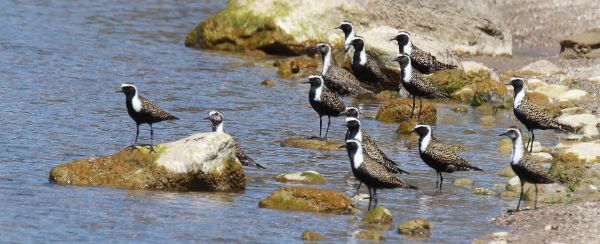
Carlson Lake also hosted the first of the big plovers to appear last week: I thought I saw the silhouette of a medium-sized plover as I passed along the east side of Carlson Lake on my way to Fargo last Wednesday morning. I questioned turning around, but did, and when I passed by again I saw 3 plovers that turned out to be 3 American Golden Plovers! As I approached the birds a small flock of 6 more Goldens was assembled nearby along the rocky shoreline – how exciting! I pulled onto the shoulder, parked, and walked toward the shore, where I realized there were many more plovers that expected, 36 in all, and they were alerted.
Even so, the exquisite Golden Plovers permitted me to take quite a few photos from a distance, and I extended the area that would be in focus by changing the aperture setting to f-11 before the Goldens repositioned downshore. That move prompted me to return to my drive and leave the rarely encountered shorebirds during their migration stop between their wintering range in southeast South America to some part of their Arctic nesting range that extends from northern Canada to northwest Alaska. I sure hope to see more, but I’ve only seen them during 1 spring migration before – last spring.
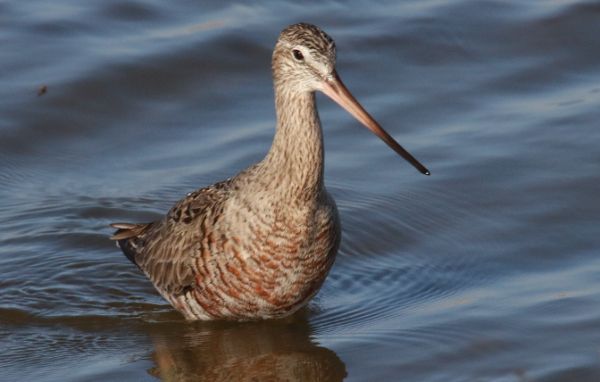
I was especially happy to be photographing a variety of shorebirds late Friday afternoon, starting with a pair of Hudsonian Godwits, and I repositioned forward only to see the first trio of Ruddy Turnstones was positioned near the extended shoulder of the road. During that photo session, a sudden sighting of a distant Buff-breasted Sandpiper excited me as it made its way along the opposite shore of Bobby’s Bay, 2 miles north of my office. At one point I saw the rarely encountered shorebird stand high and cup its wings forward, a classic display of Buff-breasted Sandpipers, although it was mostly facing away from my position.
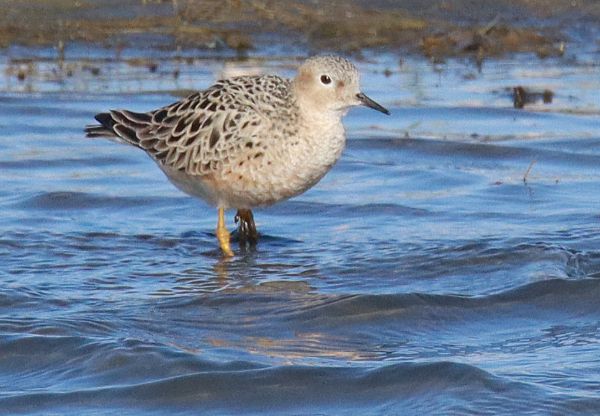
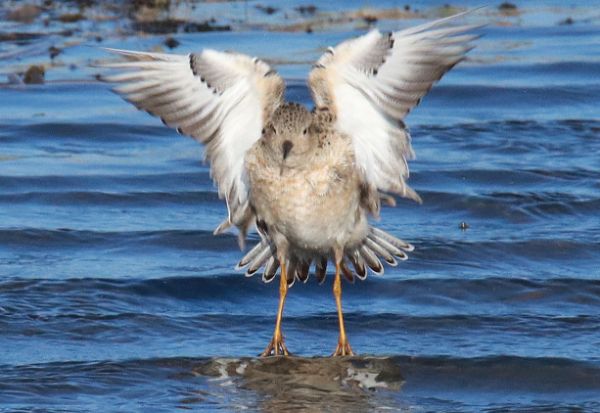
As it reached the closest point across the Bay, the lone male Buff waded into the water and began an extended bathing session complete with 2 wing-flapping actions to clear water from its plumage. The wing flaps provided a couple interesting photos that show the Buff raise above the water surface. There is something about Buff-breasted Sandpipers that is especially attractive to me (and many other birders), probably because of their interesting displays that are most inspired when in the company of females.
It is still early in the period when Arctic-nesting shorebirds , including the 5 species that appeared during the 4 days described last week, so I’m hoping this string of sightings and photo opportunities continues, including much better (closer) photo ops of Buff-breasted Sandpipers. I should have 2 weeks to relish any other chances to photograph the Big 5: American Golden Plovers, Black-bellied Plovers, Hudsonian Godwits, Ruddy Turnstones, and Buff-breasted Sandpipers!
Article and Photographs by Paul Konrad
Share your bird photos and birding experiences at editorstbw2@gmail.com