
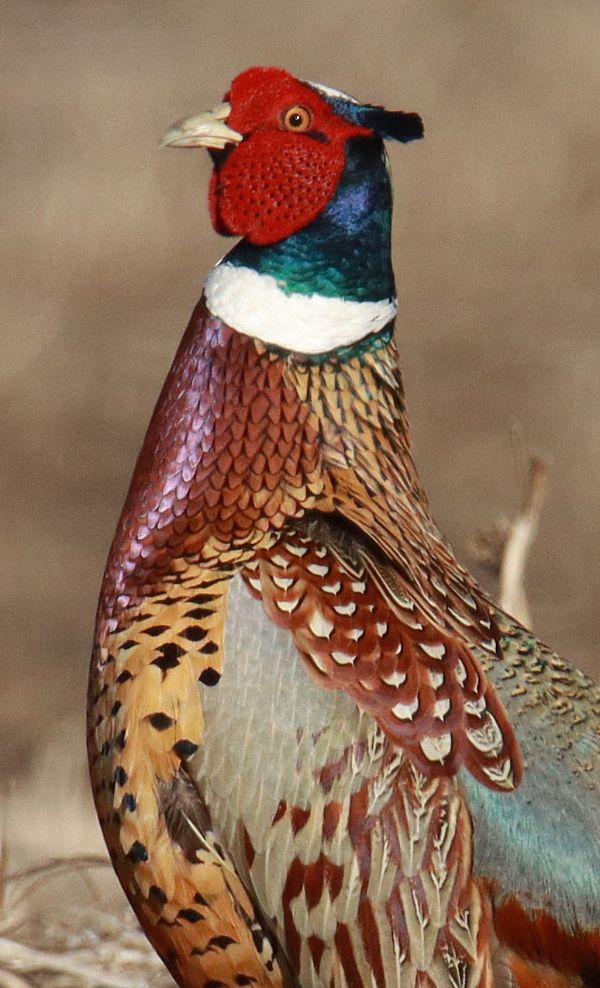
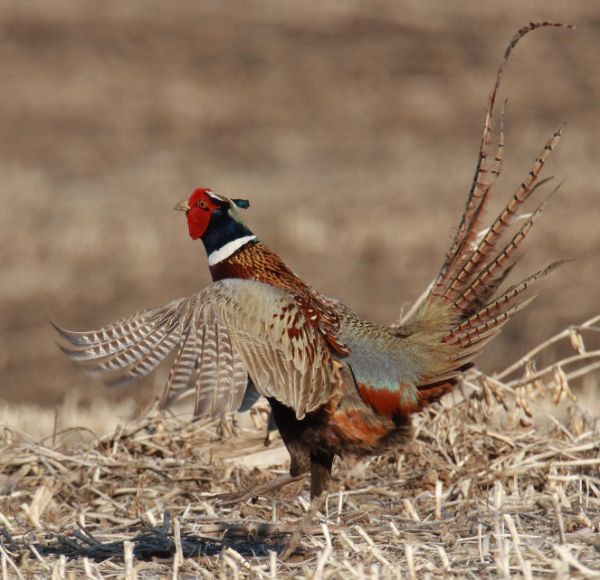
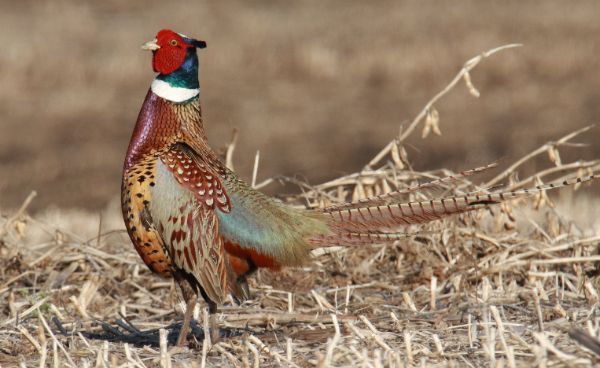
Ring-necked Pheasants have become more obvious during the past 2 weeks, and males in particular are showing advanced signs of spring in their behaviors. A week ago Sunday I observed a male displaying to a female with its plumage puffed while staying low enough to look her in the eye. I continued north a couple miles, and about 15 minutes later observed another male and positioned myself for a photo. I hoped he might do more than offer the head-high strut he was advancing, when I heard another pheasant cock crow in the distance, I expected my photo subject would answer, which put me and my shutter finger on high alert.
I was surprised that it took about 40 seconds for the gaudy rooster to respond, but suddenly he raised his beak high and crowed as he began a wing flap while raising and spreading its tail in super-fast action. At first the pheasant was facing away from me (toward the distant male), but in the excitement of the crowing sequence the rooster turned to show a bit more of a side view and the chance for a couple nice photos, including some impressive post-crowing images. I have found that photographing a crowing pheasant is one of the hardest things to accomplish as a bird photographer, so I was glad to get this initial photo series of the first pheasant I have seen crowing this spring!
Ring-necked Pheasants were introduced from the heart of their native range in China to areas of North America and Europe more than a century ago, and have become a vibrant part of many American and Canadian bird communities. The Ring-necked Pheasant has even been adopted as the state bird of South Dakota. Pheasants are among the most colorful birds, and they always evoke a thrill when encountered while birding, or under any other circumstances.
Drawing parallels between pheasants and chickens does have a basis in biology. The pheasant family, Phasianidae, includes many species of true pheasants, mostly of Asian origin, and their suggested ancestral stock – junglefowl – which show an obvious connection to domestic chickens in their overall look and behavior. And a basic aspect behavior of the fowl and pheasant family is the vocal crowing of males – also known as roosters and cocks – as part of territorial and mating behaviors.
When searching for tigers in the foothills of the Himalayas in northern India, roosters were crowing often – Red Junglefowl roosters that is. So I’m always excited to hear a rooster crow, with or without an associated sighting, but to see a pheasant crow is relatively rare, and to have a chance to photograph a colorful Ring-neck is especially rare, but at the same time exciting and rewarding!
Article and Photographs by Paul Konrad
Share your bird photos and birding experiences at editorstbw2@gmail.com