
Sitting on the cool ground in the early morning darkness felt right as we waited for first light with other-worldly sounds emanating outside the tent blind, made by what looked like gray ghosts. How’s that for an introduction to photographing Sharp-tailed Grouse at the lek where they gather in anticipation for mating? The grouse had already endured many cold dark mornings of dancing and displaying, before sunrise and after, to predicate little skirmishes. And for the dominant males positioned in the center of the lek, the possibility of mating with females that visit the lek to choose a male added even more intensity to the lek activities. Witnessing these annual rites of spring is difficult, but constitutes a rite of spring that every birder should experience.
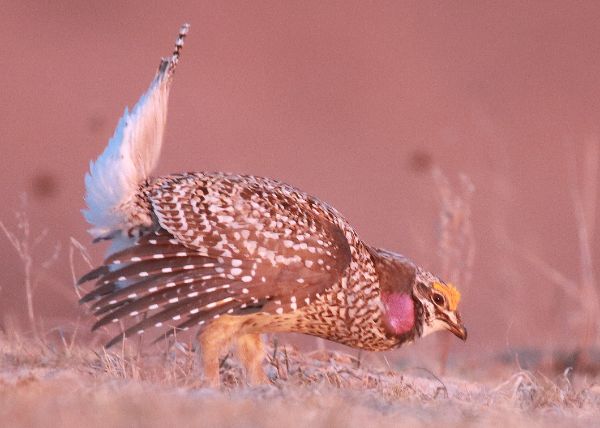
As the first rays of sunlight broke above the horizon I began to test the levels of solar illumination as the grouse continued to dance, sometimes in groups, sometimes one-on-one, calling, cooing, even cackling at times, with periods of stare-downs and possibly, moments to catch their breath as they laid on their belly but ready to spring forward in a split second to resume Sharp-tail interactions. To get true colors, it would take a bit more waiting for the sun to be positioned higher in the sky, but while the early morning sunlight was dim and absolutely tricky, it was very interesting and worthy of surprises with the understanding that what you get photographically was not necessarily what you imagined or expected.
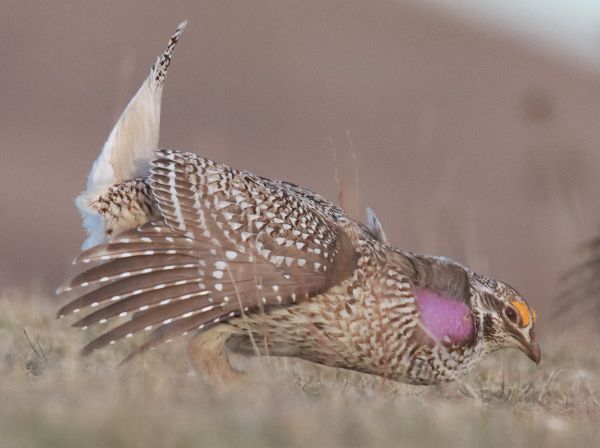
The low light quality dictated the tech settings for my camera, with my aperture set at the lowest (narrowest) position possible, f-6, to provide the fastest possible shutter speed to try to stop the ultra-fast action of the grouse performances. That was not nearly fast enough to take a photo using my usual ISO of 800, so at a level of desperation I increased the ISO setting to 1600 and waited for the sunlight to become brighter. My first successful photograph was taken with a shutter speed of only 1/250, which is half the speed I would prefer, but for a single photograph – my favorite photo of the morning – it worked. That photo was taken 16 minutes after sunrise, and I took the second best photo 42 minutes later, when the sunlight was quite bright and the shutter speed was 1/2500 – fast enough to stop any grouse action.
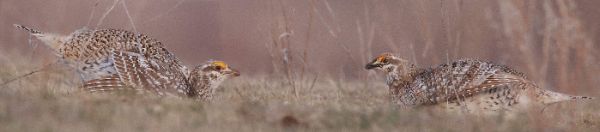
Earlier in the morning I did try to take some low light, slow shutter speed photos that would show motion, maybe even some ghostly images in the gloom of first light. But ultimately they didn’t materialize as publishable images of Sharp-tail action at the lek in the midst of especially exciting, active, interesting rites of spring in the open grassland. Some years ago I photographed at a Sharp-tailed lek southwest of Bismarck with my friends Keith and Jeff, and I photographed Greater Prairie Chickens in Wisconsin soon after moving from southern California to rural North Dakota. But every spring I’ve wished for a chance to photograph at an active Sharp-tailed Grouse lek again, but opportunities were always between distant and nonexistent.
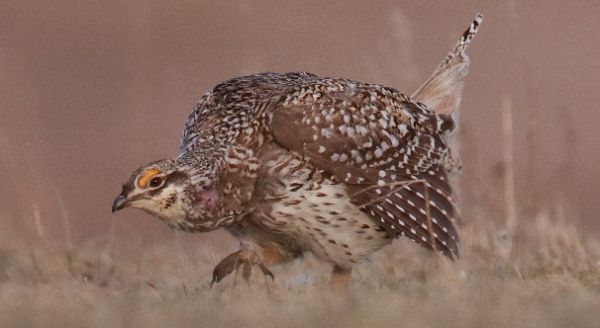
Photographing at a Sharp-tail lek is a tough experience on the best of days that requires waking in the middle of the night and getting to a photo blind before first light; then waiting and hoping for the best during an extra-cold morning a couple hours in mid-April. But that’s after you have a lek site located (the most difficult task) and a photo blind already set up. A few weeks ago I received some new information and made a new birding contact through a couple phone calls and arranged to meet a small group of birders led by Drew, who studies grouse, pheasants, and similar birds in North Dakota. Drew certainly made the experience easy and enjoyable, and through his advance efforts I appreciated the chance to fulfill a long-time interest to photograph Sharp-tailed Grouse displaying at their lek. Thanks in a big way Drew! I hope every birder makes an effort to experience seeing the lek action of a grouse species – it’s a unique and thrilling way to see these birds in a very different way!
Article and Photographs by Paul Konrad
Share your bird photos and birding experiences at editorstbw2@gmail.com