
Action photographs are almost always the most attractive photos to view and they are always encouraged in this weekly feature, for their added interest and sometimes for insightful behavior that’s revealed. But the chance to take an action photo is often fleeting and can take extra time in the company of a trusting bird, waiting with the hope for an activity to begin. When you do have the opportunity it’s best to take a series of photographs, and in the excitement of the moment you are most likely to do just that. Sometimes it will be a single bird, sometimes it will include interactions between birds, but we never know what birds will do next.
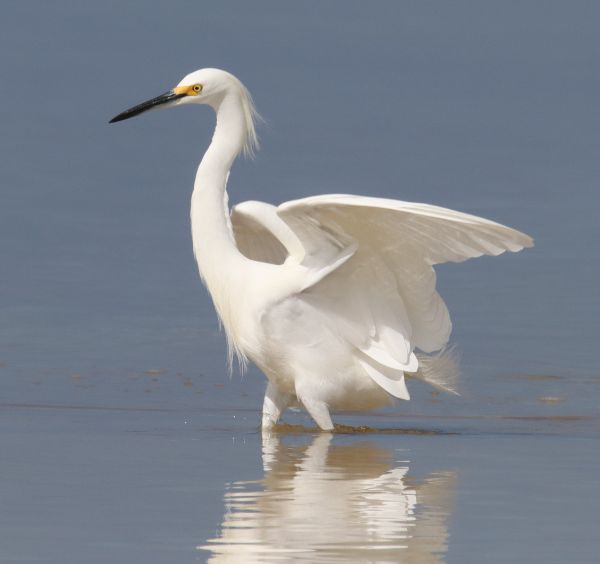
After taking a number of photos you can pick out 1 spectacular photo, 2 associated action photos, or a series of 3 or more photographs. That’s when the process becomes part of the photo review – usually on the full screen of a computer after the photo session. That’s when the creative process begins as you judge how the photos tie together, how they should be cropped, and whether to emphasize each photo individually or tie them together as an interesting series.
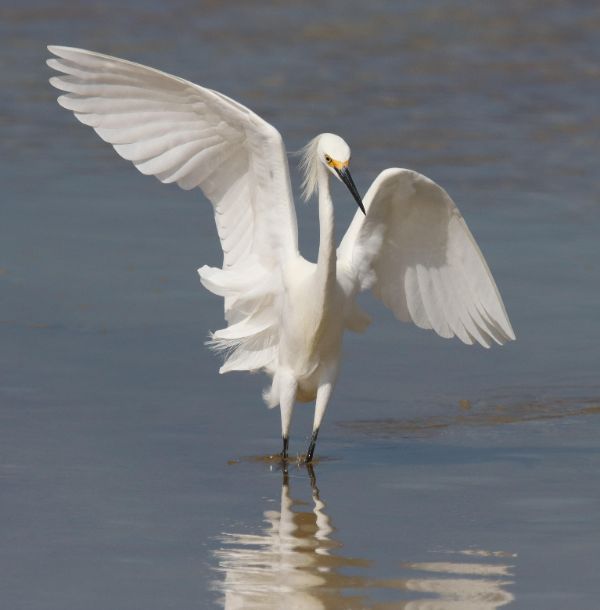
While selecting plover and sandpiper and oystercatcher photos for last week’s Coastal Shorebirds photo feature, I ran across a favorite series of action photos I took with my brother Jim at a little lagoon on the edge of a favorite beach in south St. Petersburg, Florida (in Fort De Soto Park). I was caught up in my first chance to photograph a pair of American Oystercatchers, and when Jim circled back to my position, he took a few more images too. As we stood within a few feet of one another, we were aware of a Snowy Egret working its way ever-closer while becoming ever-more active in its search for small fish in the tranquil shallows.
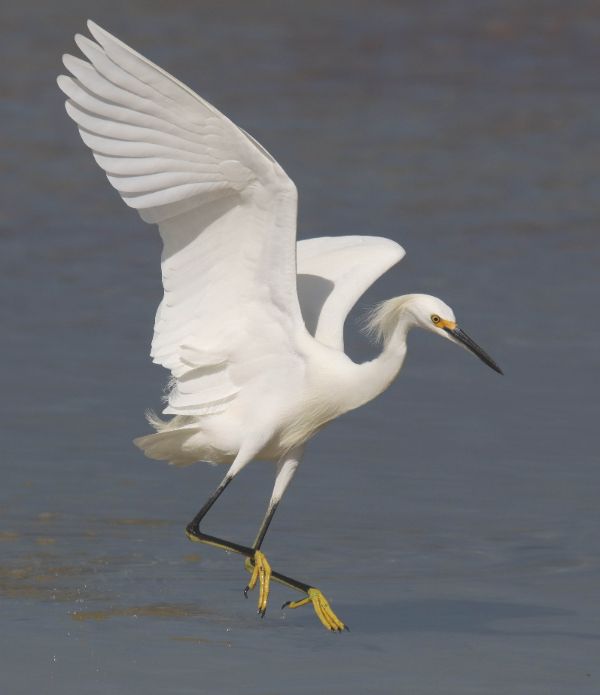
Suddenly, the Snowy’s unexpected and increasing actions in the form of spreading its wings and prancing through the water attracted our immediate attention as we simultaneously pressed our cameras quickly into action. The lighting was beautiful, a bit subdued with the glassy blue-gray color of the water providing a perfect background that emphasized the white egret in action. Even the shadows were subdued, which enhanced the beauty of the bird as it danced and ran and spinned, then lifted up on pure white wings to drag its yellow toes along the surface of the water to chase small fish before it.
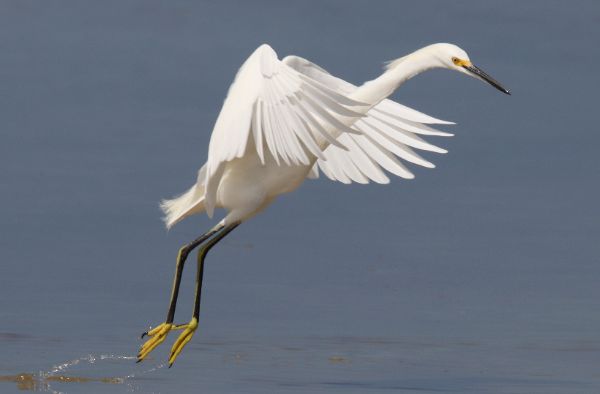
This was definitely the most action I’ve seen among the many, many Snowy Egrets I’ve observed over the years, so it was creating a memorable photo op with an equally rare chance to share a photo session with my brother Jim. It all happened pretty quickly, and between the two of us the sound of our dueling camera shutters was testament to the attraction of this egret’s unexpected behavior. The action was reminiscent of a Reddish Egret, but frankly, the Snowy showed more elegance and agility, thereby providing a series of primo photos.
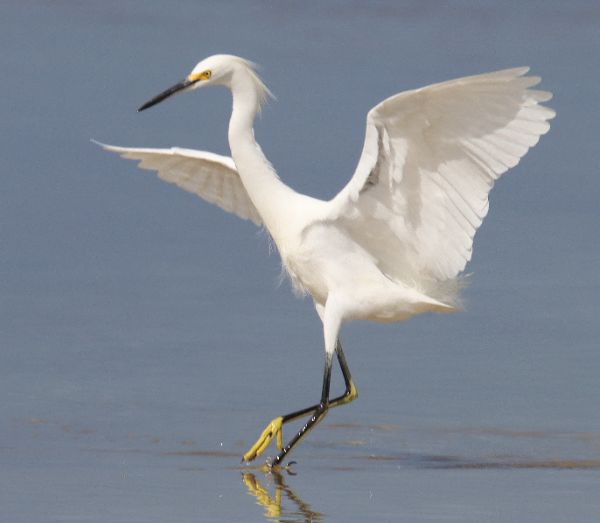
The action photos that illustrate this feature were all taken within a minute of time, which underlines the importance of being alert, reacting to the birds around you (even if they aren’t your current photo subject) and to follow the action with anticipation for the next move, even while reacting to the current movements. As usual, I had my camera’s Al-Servo (Drive Mode) set at “Continuous,” so I could take a rapid series of photos at a rate of up to 7 per second (tops with my camera model). Using this setting, I could take a single photo, or take 2 or more at a time when I held the shutter button down during a flurry of action. I tried to anticipate the egret’s next move, or movements – a split-second endeavor and oh what fun it was to have such an animated, graceful, beautiful bird actively creating its own avian ballet before us.
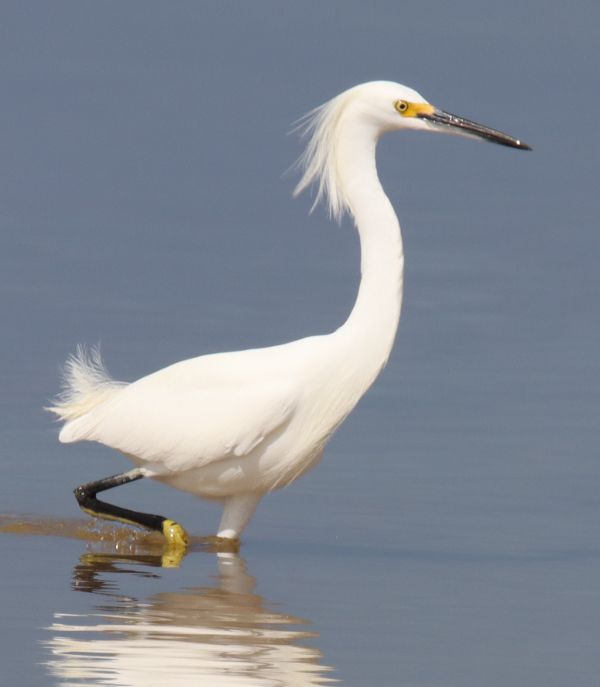
It’s automatic for me to hold my breath whenever I press the shutter button and I held the camera and lens as steady as possible while following the egret’s enthusiastic activity. My zoom lens does have a Vibration Control technology that permits hand-holding the lens that was zoomed to 500mm, which permitted me to follow the egret’s movement free style. I was already in position with the sun behind me and the egret in front of me for the best possible lighting. I was also trying to be aware of the shadows on the bird, sometimes created by its own wings, but the action was so quick that it was impossible to make any adjustments.
I can’t recall how the egret ballet ended, but I remember how excited Jim and I were in the moment, as we quickly checked our camera screens to review a few photos to verify they were as good as we hoped. I share my best ballet images with you here, and hope you find trusting birds to photograph during March, even if they don’t dance for you in the process – Good Luck!
Article and Photographs by Paul Konrad
Share your bird photos and birding experiences at editorstbw2@gmail.com