
A duck is a duck, right? Not even close. What non-birder would look at this bird and call it a duck? Its beak is thin and almost pointed, unlike the large, flat beak characteristic of ducks. It swims, but does it have webbed feet? Hard to tell when it’s swimming or flying – its normal modes of action. And then there is the remarkable, defining, characteristic “hood,” that seems inflatable, an ornate feather crest the species can raise up, fully or part-way, or lay the hood flat against its neck. This hood can be used in behavioral displays, during courtship and during agonistic interactions – and it gives the bird its name – Hooded Merganser.
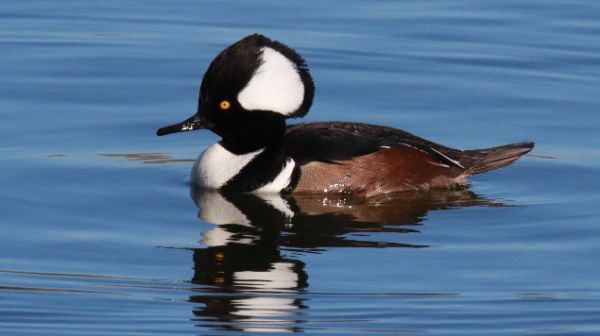
Merganser? Yes, and mergansers are specialized Ducks that have narrow specialized bills they primarily use to catch small fish, aquatic insects, and crustaceans, particularly crayfish, and Hooded Mergansers have eyes that are well-adapted for underwater vision. Hooded Mergansers are quite impressive birds to view, and they are especially fun to photograph. Fun to photograph if you can find one – find one in a location where you can position yourself between the bird and the sun, and find an individual that will permit a close approach, but not so close that the bird becomes concerned or changes its behavior.
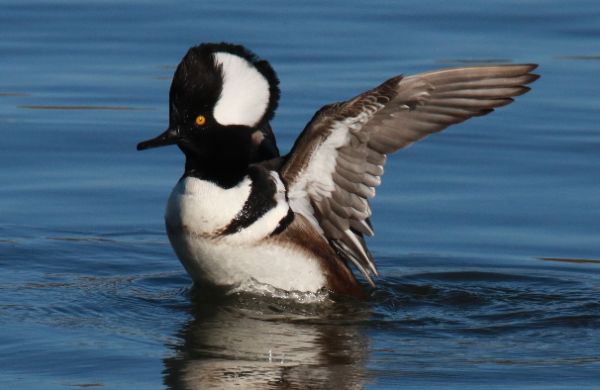
In a very best-case photo scenario, after you get into a nearby position, it is the Hooded Merganser that moves closer, swimming or even diving and surfacing closer to your direction. I call trusting birds like these “species ambassadors.” They are usually rare, or really rare, so when you find a trusting ambassador, by all means take advantage of the opportunity with your camera. But even with an ambassador, be courteous and give the bird adequate space so it behaves naturally – as if you were a tree. The bird always comes first, and if the bird is changes its behavior or moves away from you because of your movements or sounds, stop, back up if necessary, and let the bird calm down again. If you are really lucky, in time the bird might even move in your direction.
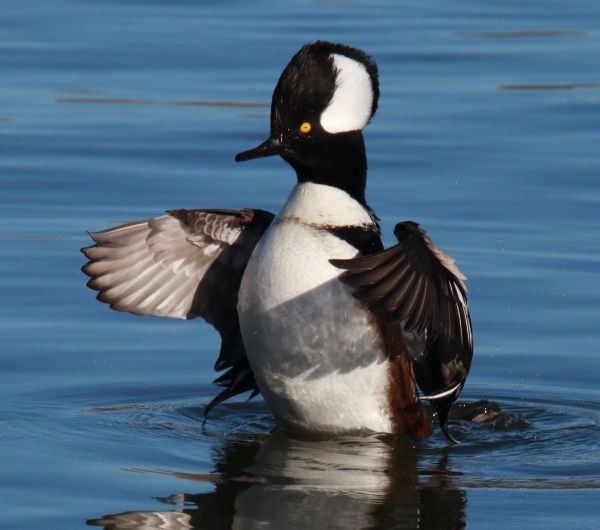
That’s what happened during my photo interaction with a Hooded Merganser in the Pierre, South Dakota area recently. This far north, ponds and marshes are frozen, but some rivers and backwaters provide open water for the very hardiest of waterfowl. Even though other ducks were present, the fine Hooded Merganser stood out as it was observed near other Hoodies, Common Mergansers, Mallards, and Common Goldeneyes. There were female Hooded Mergs too, but none that appeared to be open to being photo ambassadors. Nonetheless, I have had chances to photograph other female Hoodies during winter, and I include a photo of one that showed her grace, colors, and form.
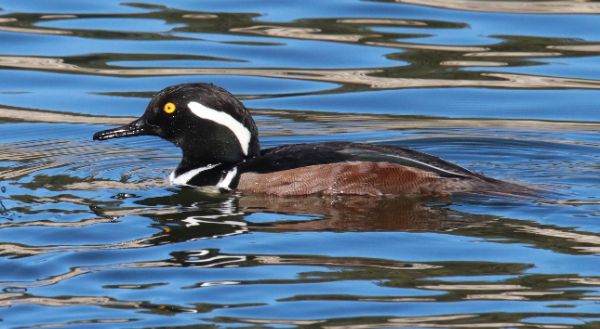
All the photographs that illustrate this article are illuminated by full sunlight with the sun positioned at a 45-degree angle above the horizon, which is the best you can ask for when photographing any birds. By positioning between the sun and the bird, and making sure your shadow points toward the bird, shadows are eliminated for the most part. In this position the sun also provides the best quality of light that produces the best colors – and that’s the most important part of photography, after you get into a position with the bird that doesn’t disturb it.
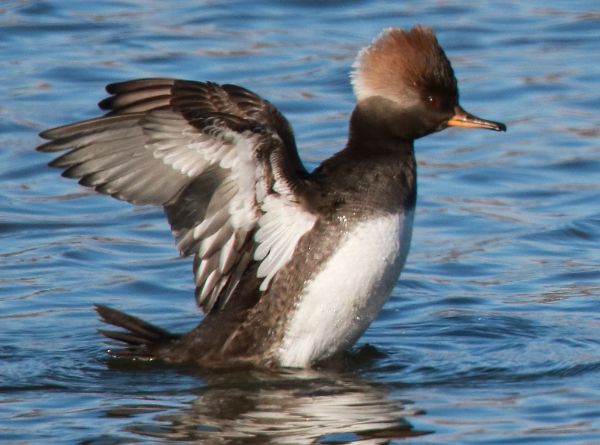
If the bird isn’t disturbed, it does its normal variety of activities that may include swimming, resting, preening, diving, and an occasional flap of its wings, which may accompany a preening session. If you are lucky, you may be able to photograph the bird displaying to a potential mate, or maybe you will witness and photograph an aggressive interaction or even a limited “fight” between would-be rivals. You may also get to photograph a takeoff, or maybe a bird flying by or even landing in front of you. Anything is possible, and it’s always worthwhile spending some extra time with a bird or birds, watching and waiting for a chance to get some more interesting photographs. That extra time at a distance can also convert into an improved level of trust and may even give the bird time to move closer to your position. That’s really what happened in my case: The drake was pretty trusting to begin with, and eventually permitted me to follow it along the river’s edge. Plus, when the Hoodie would dive, I took advantage of the moment to close the distance a little more before it surfaced again.
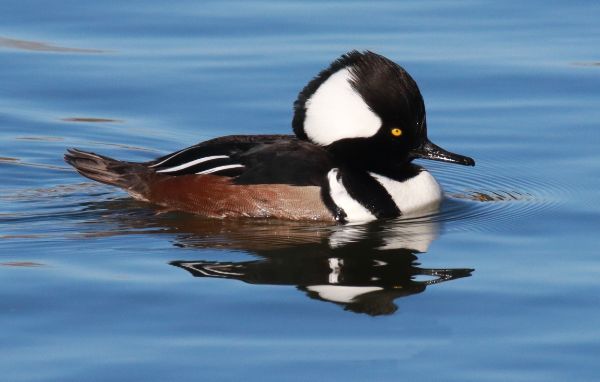
Ducks are always fun photo subjects, and while Hooded Mergansers are not very common within their expansive range, they provide some interesting and somewhat unique photo ops, even if they just raise and lower their “hood” a bit. I sure enjoyed my time with this hooded ambassador, although I took these photos in a relatively short period; less than half an hour. The time was well spent considering I was able to produce some favorite photos of the species – the unique Hooded Merganser. Enjoy all your photo encounters!
Article and Photographs by Paul Konrad
Share your bird photos and birding experiences at editorstbw2@gmail.com