
Raptors provide dynamic flight photographs with dramatic outlines varying from widespread wings and tail during soaring flights to diving or gliding views with wings bent inward. Within the same second of time a raptor can move its wings from above its back to below its underside, providing ever-changing views and images as you follow its line of flight. Rough-legged Hawks provide some added flight opportunities because they often employ hovering as part of their flight repertoire when hunting on the wing.

Rough-legs also offer a variety of plumages for birders to photograph that include some subtle variations among adult females and first-year hawks. But in the case of adult males, each male is unique to some degree, especially in the pattern and colors that can be seen on the mostly white underside of a male hawk. Showing as varied forms of lines, spots, and bands of colors that range in shades of gray to black, tan to brown, and sometimes showing all 4 of these colors in interesting patterns against a base of white feathers. As a result, males tend to be more showy, but they also seem to be less common among birds wintering south of their Arctic nesting range. One more plumage is more common among Rough-legged Hawks than other raptor species – the dark morph individuals that have a fairly uniform chocolate brown coloration among females, and dark brown to jet black plumage among males.
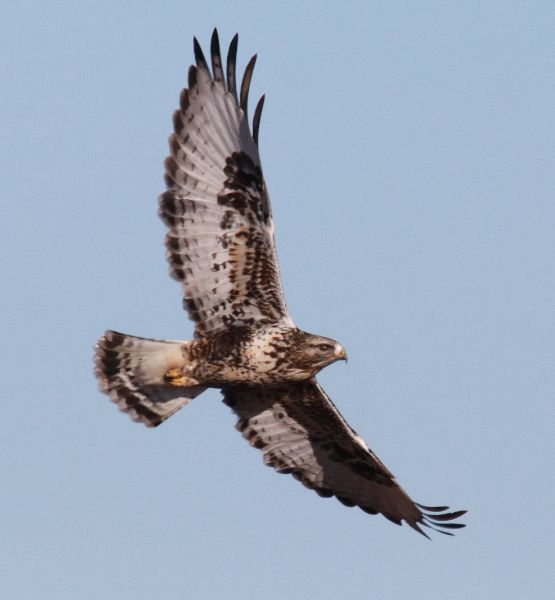
During the recent holiday break, the most commonly encountered birds in my area after Ring-necked Pheasants were Rough-legged Hawks. It started with a couple Rough-legs nearby, including a dark morph male just 2 miles west of home, and a female 12 miles north on December 15th, but the real breakthrough was December 23rd when I was surprised by 3 Rough-legs hunting along the same mile of mixed grassland and wetland habitat 25 miles from home. I was already running late on a drive to Fargo, so I only observed the hawks for 5 minutes under a gloomy gray sky, but vowed to be back when the sun broke through the clouds.
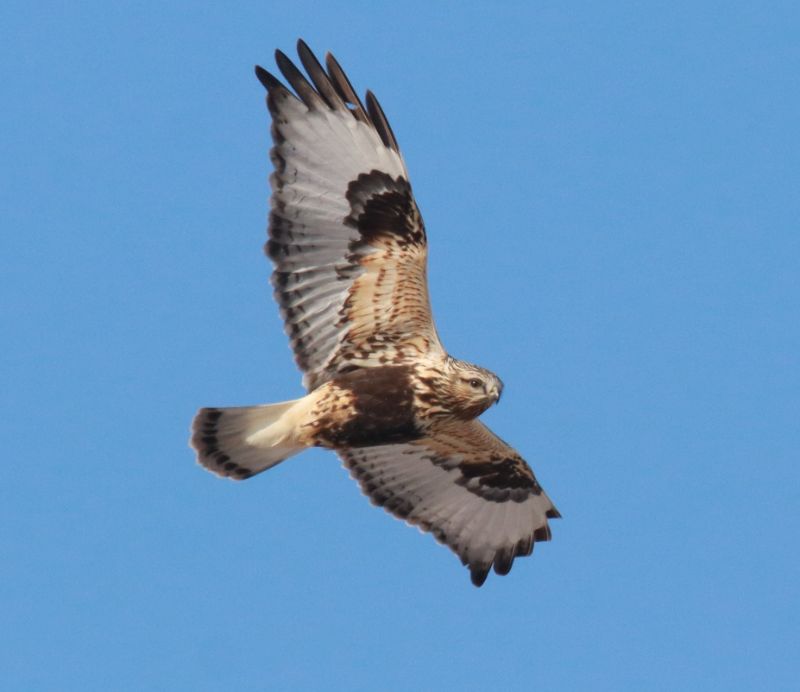
The next morning the sun shined bright, pressing me back to what I would call “The Rough-leg Plain” with the hope of photographing hawks. With more time to spend, I had a chance to observe 3 unique-looking adult males and at least 3 adult females, maybe 4 – all within a 2 square mile area. “The Plain” has a little-used road that bisects it east and west, and another rarely used road that bisects it north and south – roads that proved helpful when positioning near hunting Rough-legs that were perched or in flight, sometimes hovering.
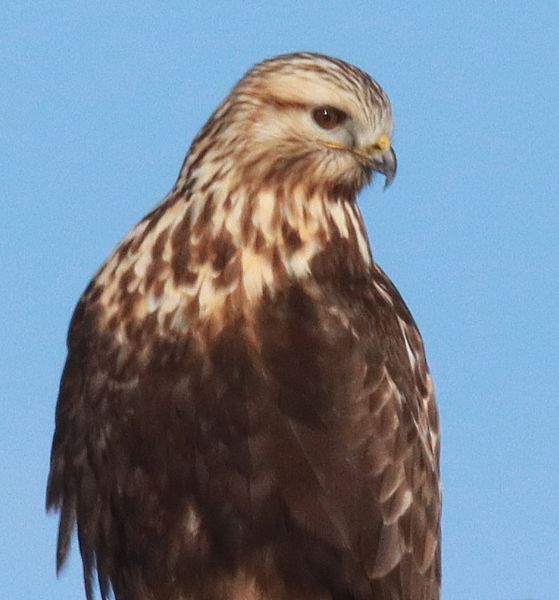
To keep myself positioned with the southern sun at my back and a bird before me, I had to make some small adjustments in my usual ways of getting into photo position. With the predominantly north wind of winter, the birds flew, glided, and hovered facing into the wind, which meant a hawk would either be showing its tail end if hunting on the north side of the road, or showing a shadowed front end if positioned south of the road, but neither option provided optimum views or lighting for photography. As a result, I began positioning south of a hawk hunting on the wing north of the road, then waited for it to turn right or left, or even circle or reposition in flight – and that’s when photo ops sometimes were created and that technique worked effectively a number of times.
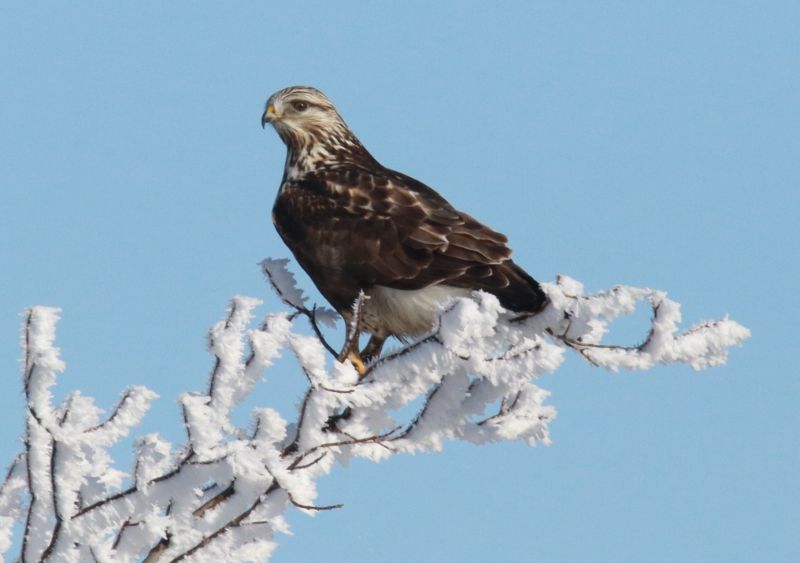
Another technique I used was to park a distance away from a perched Rough-leg to wait for it to take flight – sometimes in a downward dive toward prey, sometimes to begin the next soaring or hovering hunt on the north side of the road. Similarly, I was able to intercept the flight of a hawk as it moved to the north side of the road, and one time in particular I was able to get in position as a female flew across the road to land and perch in the midst of heavily frosted tree branches, providing an especially unique photo opportunity illuminated in the morning sunlight.
Other opportunities to photograph perched hawks were presented on occasion along the north-south road where I could approach a perched bird with the sun at my back, then park my mobile blind where I could wait for the hawk to take flight. Sometimes a Rough-leg would begin a flying hunt, or make a direct hunting approach toward potential prey it saw. I try my best not to approach too close to a perched bird, instead getting into a position where the hawk might provide a closer photo when it repositions to begin or end a hunt.
At the same time, I experienced a lot of individual variation among the hawks as to how close I could approach. Some showed an obvious nervousness at my slow approach from a distance, making me stop short of my intended parking spot. But others allowed me to park within photo range, where I waited for the hawk to initiate a hunting action – and sometimes that was to fly directly toward me, low, and I tried to make the most of each photo op that transpired. Any time a hawk is flying within photo range, it’s good to follow its movements through the camera lens as much as possible so you have the bird in focus when you anticipate it will move into just the right position for a photo, or series of photos.
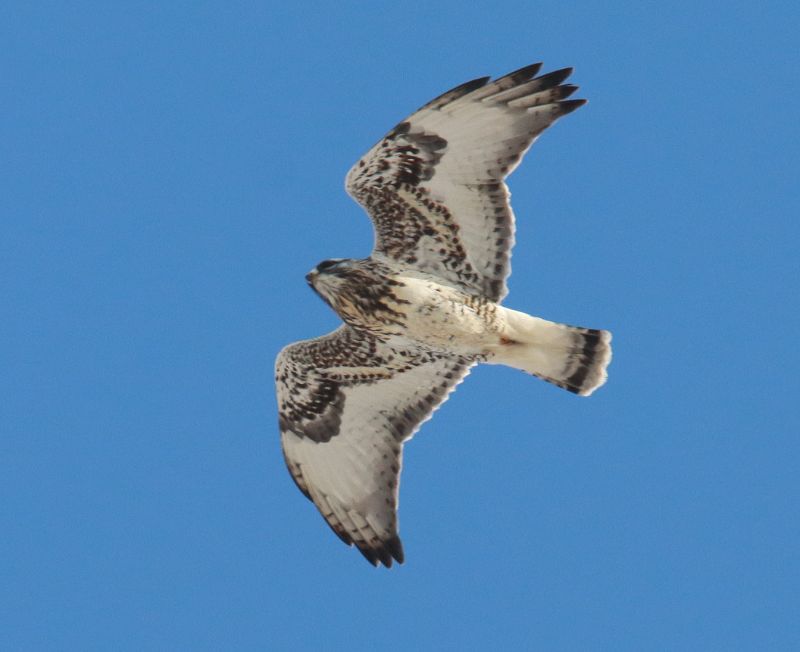
Perhaps the most unusual aspect of the Rough-legged Hawk concentration was that although I surveyed areas 100 miles to the southwest, 90 miles south and southeast, 50 miles north and 100 miles east, 35 miles northwest, and 380 miles east, I only observed 1 other Rough-legged Hawk. This species is apt to gather in small hunting groups like I encountered at The Rough-leg Plain, which is most likely because the immediate area is a rich open hunting site with an abundant population of voles. But there are many, many similar or better hunting locations along the transects I described above. Why there, and seemingly nowhere else?
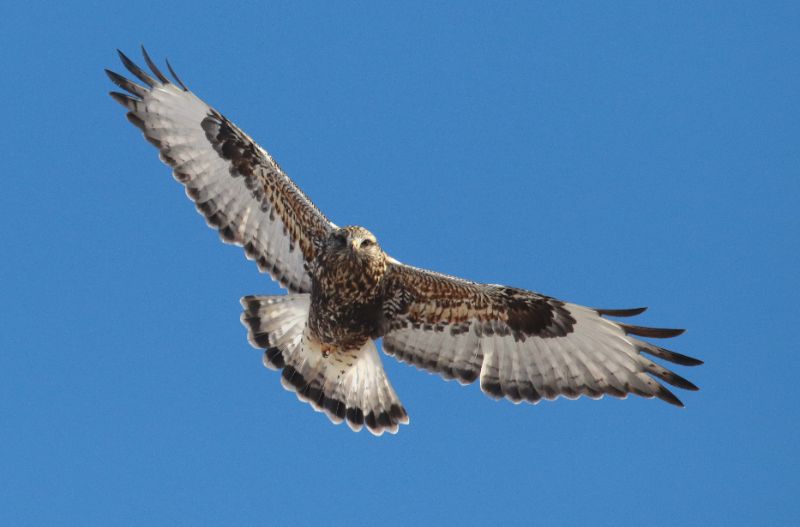
The area experienced a pretty intense blizzard for 2 nights and 1 day between Christmas and New Years Day, which I feared would push the raptors farther south, but most continued to hold their ground at The Plain. All I can say is: I was especially happy to be able to visit and revisit this wintering group of Rough-legged Hawks so close to home, to observe their behaviors, movements, and hunts while having a variety of opportunities to photograph these Arctic-nesting hawks from the far north lingering for an extended period within a half-hour’s drive of home! I hope you enjoyed some fulfilling birding experiences over the holiday season, camera in hand and look forward to many more during the new year ahead.
Article and Photographs by Paul Konrad
Share your bird photos and birding experiences at editorstbw2@gmail.com