
For almost a week, I appreciated a roller coaster of Short-eared Owl photo possibilities, before and after the coldest, windiest period of the winter, with a total white-out of blowing snow mid-week. Some days the owls were present, some days they were not to be found. Some days they offered photo opportunities, some days they didn’t. Case in point: Last Thursday there were no owls to be found during 2 site checks. But the following day, the 3 original owls were on site, and 3 more were found 5 miles away, doubling the number of owls from 3 to 6. Saturday the new owls were not to be found, but 2 were hunting on the wing at the original site Saturday afternoon, with none to be found Sunday or Monday.
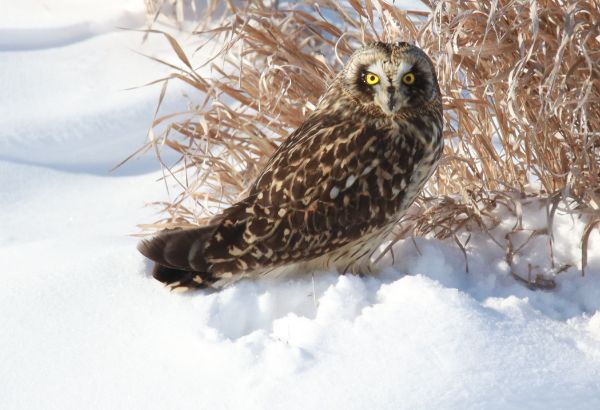
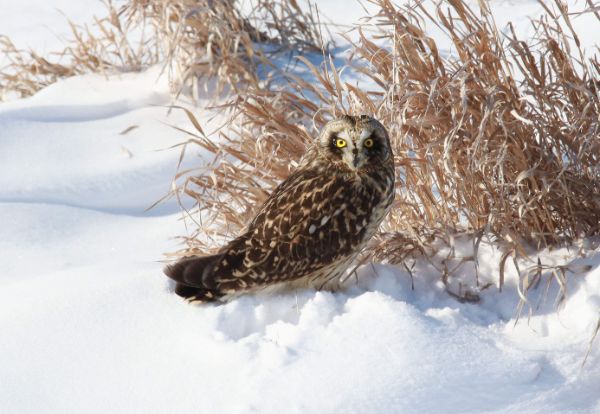
Friday morning, although the temperature was still –17 degrees, there was sunshine galore but only a light wind, so I couldn’t hold myself back from checking on the potential of birds. Realistically, the potential was remarkably low, and dropped even lower after passing through the area where Short-eared Owls were active Monday and Tuesday without sighting a feather moving. But I kept driving south and bam, a Short-ear was perched on a low post near the road 5 miles south of the Monday-Tuesday hotspot. And then there were 2, and even 3 Short-ears!
I spent the next hour observing and trying to photograph the hunting and perched owls above the hilly grasslands. It was fun, exciting, and a bit frustrating, with the owls tantalizing me with would-be photo opportunities, but not following through time and time again. Well, that’s part of the challenge of getting a good species photo, and in this case, there were many photo challenges. What was a bit frustrating about the owls was that as they hunted on the wing, I would follow one owl’s flight through my camera lens, waiting for it to turn in my direction, but almost always the owl turned away.
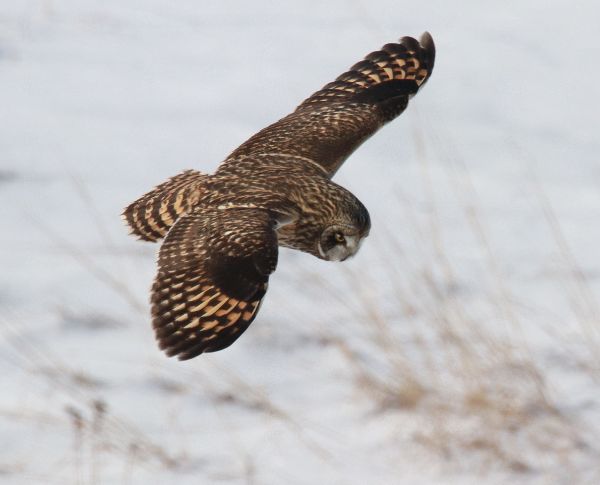
Another part of the problem was the direction of the wind; the owls tended to face into the northwest wind as they hunted on the wing, but the sunlight was coming from the south-southeast. That meant the back-half of the owls would be nicely highlighted, but the front side including the face would be shaded. It also seemed that my usual ability to anticipate an owl’s moves and turns wasn’t in line with what they actually were doing. Eventually, I realized I had a pair of traits in my favor – perseverance and persistence.
Even so, it was an especially fun activity, but the owl action settled down after about 90 minutes; so having learned more about these open-country owls during that period and getting a few interesting photos, I drove back north. Five miles north, as I reached the hilly grasslands where I found the first trio of Short-eared Owls, I slowed to a crawl and darned if there wasn’t a Short-eared Owl flying low ahead of me! Almost immediately it made an attempted capture of a likely vole, and a moment later I caught sight of a second Short-ear on the wing, and eventually a third owl – all in sight at the same time! This observation was a breakthrough after not seeing an owl during an earlier search of the area less than 2 hours earlier, or Wednesday and Thursday. Now I ascertained there were at least 6 Short-eared Owls in the areas 7 miles and 12 miles south of the office.
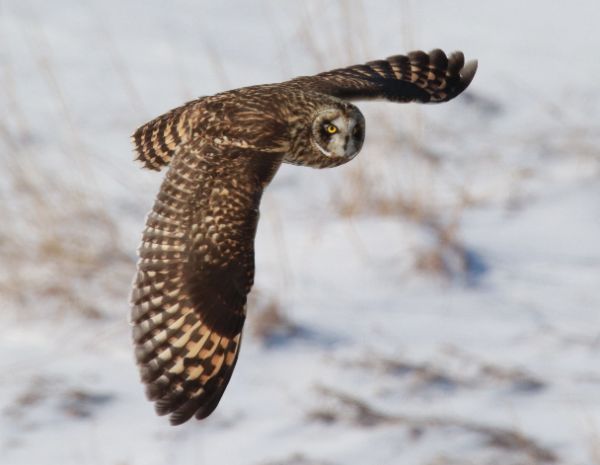
That evening, my photo frustrations vanished when I was able to review the photographs I took earlier in the day. Sure, many didn’t turn out or weren’t up to publication standards, but there were plenty to appreciate. I selected a few to illustrate this feature and the Editor Afield article in this issue. The photos of perched owls presented in the Editor’s article were taken late Tuesday afternoon in waning sunlight and after sunset, while the photos shared in this article were taken during early afternoon Friday in full sunlight.
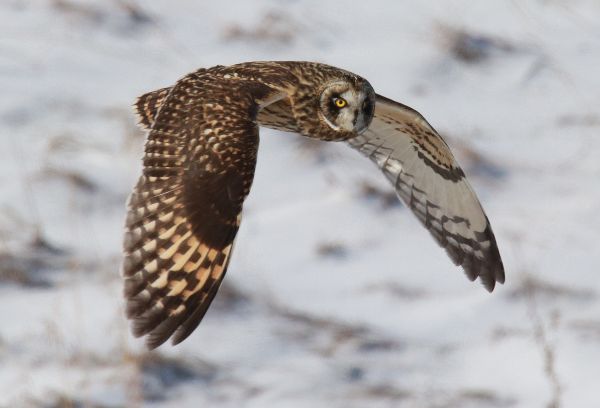
The most important takeaway was how the sunlight made such a difference in the sharpness, colors, and definition of the birds in flight photos and when perched. There was a real standout series of photos that I share here that was taken as one of the owls flew toward my position as it hunted along the slope of a sunny hillside. The first photo shows it approaching with its head down, watching and listening for rodent movements; then it raised its head and looked my way at just the right time while slowly flapping its wings down and up.
Short-eared Owls can be quite endearing, especially when you have a chance to spend time in their company as they rest or hunt from a low perch. They seem to have a friendly nature and they are quite cute, but these are fairly anthropomorphic attributes and in reality these owls are first and foremost predators – pretty good predators considering the number of voles I saw them catch. Which brings up the other enjoyable thing about Short-ears: To have a chance to watch them during their low flights above the grasslands. They have very long wings that give Short-ears a unique look, and their flights make them look so buoyant and light-weight – almost “bouncy” at times.
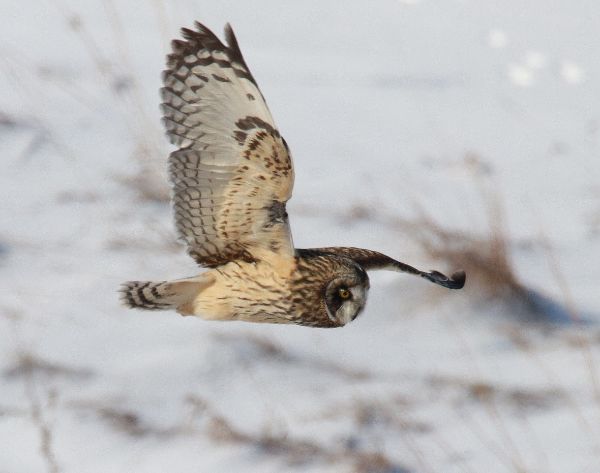
Without a moment’s notice these owls can turn as quickly as any bird can move, changing direction right or left, up or down, making 45-degree or 90-degree turns in a split second, only to resume their bouncy flight and circle while watching and listening for movements on the ground or snow, turning this way and that, even hovering for a moment. I find the Short-eared Owls’ flights to be especially pleasing to watch, but to be honest, the biggest payoff is getting some photographs that characterize the behaviors of Short-eared Owls during the coldest wind-chilled temperatures in the Northern Plains. Good Luck as we begin February birding activities – stay safe and be prepared for inclement weather while enjoying the birds around you.
Article and Photographs by Paul Konrad
Share your bird photos and birding experiences at editorstbw2@gmail.com