
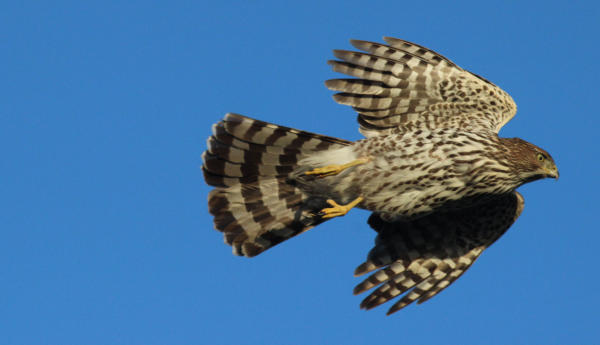
An immature Cooper’s Hawk in speedy flight.
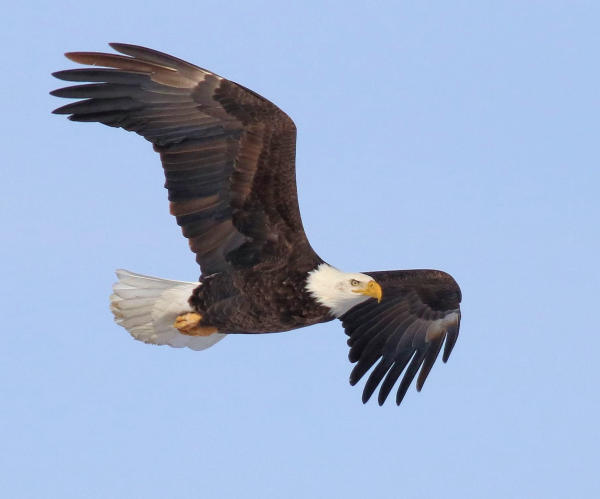
Wish for a majestic adult Bald Eagle to migrate past your position.
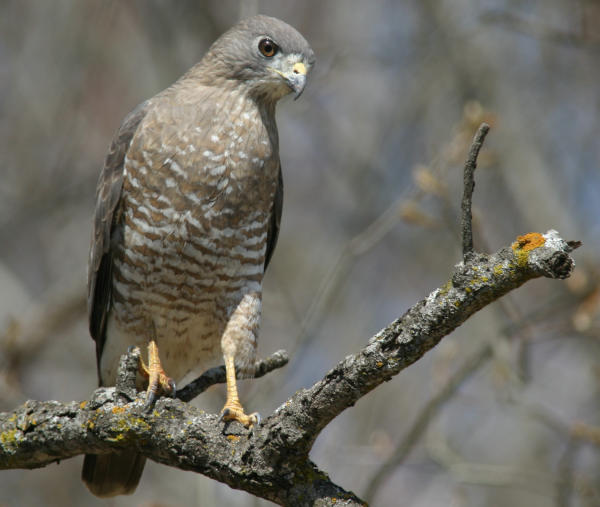
A Broad-winged Hawk resting during a fall migration stopover.
|
Wow, it’s September already! As I think ahead about favorite fall birding destinations, my first reaction is early season raptor migration at Hawk Ridge in Duluth, Minnesota. The promise of a mid-September peak migration of Broad-winged Hawks, which brings thousands of these smallish Buteos funneling down the north shore of Lake Superior, is well worth a pilgrimage to the edge of the Great Lakes. The peak Broad-wing migration day last year was September 17 with 26,270 recorded. The record daily count was 101,698 Broad-winged Hawks on September 15, 2003 – truly a day to remember!
There is nothing like standing on a high overlook and watching for the next eagle, hawk or falcon to glide by, then another and another. You quickly become so tuned in that you can’t miss one of the raptors even though they pass by at different distances and elevations. The repetition of identifying species after species helps you feel more certain about your raptor identification skills. What fun as an impressively close Bald Eagle wings by, giving way to a trio of immature Cooper’s Hawks that pass by one after another, followed by a female Northern Harrier and a classic “kettle” of Broad-winged Hawks with a few Red-tails soaring overhead – and it continues as four Sharp-shinned Hawks pass through at different elevations, then a Merlin and an American Kestrel. What fun!
I hope you’ve had the pleasure of spending time at a hawk watch count site, or a number of them; for then you know what makes me tick each fall. If not, begin planning your first trip – or your annual fall trip – to a hawk count site near you! While Hawk Ridge is my personal favorite site, I have had memorable raptor migration days at Cape May (NJ), the famous Hawk Mountain (PA), Golden Gate (CA) and Corpus Christi (TX). To be fair, I need to visit Corpus Christi during peak Broad-wing migration, when almost all Broad-wings pass through on their way to wintering areas in Mexico, Central America and northern South America; today Mississippi Kites are the most abundant migrants passing through Corpus (1,084 counted Saturday!). Other exceptional fall sites include Gashute Mountains (NV), Holiday Beach (Ontario) and Mackinac Straits-Point LaBarbe (MI) to name a few.
It’s easy to find a hawk count site near you, thanks to the Hawk Migration Association of North America (refer to their website listed below). While you’re at the site, check out some of the many hawk count sites cross-country to see what kind of raptors are migrating throughout the fall season. You can literally check raptor counts site by site each day, sometimes in real time as the official hawk counters tally them in the sky. The dominant species and their numbers change month after month, if not every two week, which makes more than one visit to a hawk count site per fall all the more fun and interesting. And visiting more than one hawk count locations is even more rewarding. If you live in eastern Pennsylvania, for instance, there are many hawk watch locations to consider for a fall visit during prime autumn colors.
As an example, let’s go back to Duluth. Hawk Ridge is famous as one of the best locations to see Northern Goshawks, with peak numbers of Gos observed during mid-October. But lately, Bald Eagles are leading the charge, soon to be bested by Broad-wings and then Sharp-shinned Hawks. While you’re on the Ridge you can monitor the daily raptor count, attend periodic open-air educational talks and banding demonstrations, and interact with fellow birders throughout the day from August 1 through November. The highpoint for many birders is the annual Hawk Weekend Festival (September 21 and 22 this year), and there are several other presentations through the fall, including three special Evening Owl Programs at 8pm on SaturdaysSeptember 29, October 13 and October 20. For more information, you can check out the action at the Hawk Ridge website (listed below).
My introduction to Hawk Ridge was back in college when my advising professor, Dr. James Grier, invited me to join him during a weekend visit to one of his grad student’s field project sites. Jim’s student, Dave Evans, was operating the banding station at Hawk Ridge, so we enjoyed insider views of the action at the banding station that was dominated by Sharp-shinned Hawks by day and Northern Saw-whet Owls by night. When I worked with Audubon in St. Paul, Minnesota, it was much easier to make the pilgrimage to Hawk Ridge for a frenzy of raptor action among fellow birders and biologists. This year it will be tougher to make the trek due to professional obligations, but l live at a great raptor migration location.
Even though the Great Plains doesn’t benefit from the funneling effects of a coastline or mountain ridge, fall raptor migration is exciting. Rather than the birds coming to you, as at most raptor migration hotspots, I must search out migrants in the area day by day. But Friday alone I found an immature Bald Eagle, a young female Merlin, a Cooper’s Hawk, an American Kestrel, several Swainson’s Hawks including an attractive dark morph, even more Northern Harriers, and many Red-tailed Hawks, mostly young of the year, a few adults and a memorable adult Krider’s Red-tail. My total during a couple hours Friday actually beat the full-day count at Hawk Ridge for August 31, a rare fete indeed.
In advance of visiting a hawk watch site this fall, keep your pulse on the fall migration and be sure to watch the weather. Daily bird migration is dictated by the wind direction and velocity, weather fronts, precipitation and changes in these factors. A big migration day and a poor one can be just hours apart. For instance, last Tuesday only 4 Bald Eagles were counted migrating by Hawk Ridge, but the next day 186 Bald Eagles passed by! The great thing is that we can monitor the weather conditions and the species counts at the larger raptor count sites by checking their websites. The Cornell Lab of Ornithology website (below) even has a BirdCast page for wind and weather info continent-wide. Raptors are everywhere, so keep your eyes to the sky, and enjoy the fall migration season – every day!
Article and photos by Paul Konrad
Share a story about your favorite raptor migration site at editorstbw2@gmail.com
Check out all the interesting information available at the Hawk Migration Association of North America’s website http://www.hawkcount.org/sitesel.php
For more information, you can check out the action at the Hawk Ridge website (listed below). https://www.hawkridge.org/
The Cornell Lab of Ornithology even has a BirdCast page for wind and weather info continent-wide http://birdcast.info/live-migration-maps/